
In today’s data-driven environment, organizations are rapidly adopting AI-powered analytics tools to improve decision-making. However, many initiatives fall short—not because of weak AI models, but because of poor data foundations. This is exactly where an AI data layer for analytics agents becomes critical.
RevOps and FP&A teams often attempt to connect AI directly to raw data from CRMs, billing systems, ERPs, or data warehouses. While this approach may seem efficient, it introduces ambiguity and inconsistency. Raw data lacks the structure, labeling, and business context required for AI to produce reliable outputs.
A properly designed data layer transforms this raw data into something AI can actually understand. It ensures that metrics are labeled clearly, defined consistently, and calculated correctly. When combined with strong prompt design, this foundation allows AI agents to deliver high-quality, decision-ready insights.
What Is an AI Data Layer for Analytics Agents?
An AI data layer acts as the bridge between raw operational systems and intelligent analytics. It reshapes fragmented data into a structured, business-ready format that AI systems can reliably interpret.
At a high level, this layer performs several key functions:
- Data transformation: Raw inputs are cleaned, normalized, and structured into consistent formats that eliminate ambiguity.
- Clear labeling: Fields are renamed using business-friendly terminology so AI does not rely on guesswork.
- Defined relationships: Connections between datasets are explicitly modeled, helping AI understand how metrics relate.
- Pre-calculated metrics: Complex KPIs are computed in advance so results remain consistent across all queries.
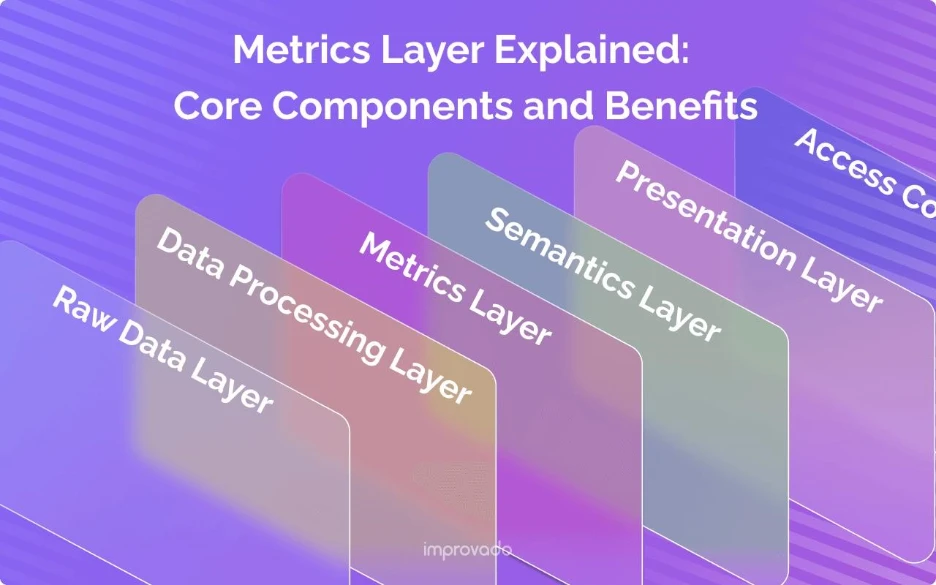
Together, these elements create a semantic foundation that allows AI to operate with clarity rather than approximation.
The Problem with Using Raw Data for AI
Many teams underestimate how difficult it is for AI to interpret raw data correctly. While modern models are powerful, they still depend heavily on structured inputs.
Some of the most common issues include:
- Lack of context:
Field names such as “opp_stg_cd” or “rev_amt” may make sense to engineers but not to AI systems or business users. Without proper labeling, AI must infer meaning, which introduces risk.
- Inconsistent definitions:
Different teams often define the same metric in different ways. Revenue, pipeline, or even “closed deals” may vary across departments, leading to conflicting outputs.
- Missing business logic:
Many important KPIs do not exist in source systems and must be derived using logic that spans multiple datasets and timeframes.
In practice, this means that feeding raw data into AI often results in inconsistent, incomplete, or misleading answers.
Why AI Requires Labeled and Well-Defined Data
For AI systems to deliver accurate insights, they must operate on data that is both clearly labeled and rigorously defined. This combination reduces ambiguity and ensures consistent interpretation.
A well-structured data layer provides:
- Clarity of meaning:
Metrics such as Annual Recurring Revenue or Pipeline Created This Quarter are explicitly defined, eliminating guesswork.
- Consistency across queries:
AI agents rely on the same definitions every time, ensuring that answers do not vary depending on phrasing.
- Reduced hallucinations:
When data is well-defined, the likelihood of AI generating incorrect or fabricated insights is significantly lower.
This is not just a technical improvement; it is foundational to building trust in AI-driven reporting.
The Role of a Metrics (Semantic) Layer
A metrics layer, often referred to as a semantic layer, plays a central role in making data usable for AI. It provides a structured environment where business logic is defined once and reused consistently.
Key capabilities of a metrics layer include:
- Standardized metric definitions:
Every KPI is defined using agreed-upon formulas, ensuring alignment across teams.
- Reusable logic:
Calculations such as conversion rates or sales cycles are defined once and applied everywhere.
- Time-based rules:
Metrics can be scoped to specific periods, cohorts, or segments without ambiguity.
For example, instead of requiring AI to construct logic dynamically, the system can rely on pre-defined metrics such as conversion rate or sales cycle duration, both of which are consistently defined across the organization.
Calculated Metrics: The Missing Link for AI Accuracy
Calculated metrics are where a data layer delivers the most value. These metrics embed business logic that cannot be inferred directly from raw data and are essential for meaningful analysis.
Some of the most important categories include:
- Pipeline and sales efficiency metrics:
Conversion rates by stage, pipeline velocity, and sales cycle duration all require multi-step calculations and time-based filtering.
- Retention metrics (GRR and NRR):
These are especially critical in subscription and SaaS businesses:
- Gross Revenue Retention (GRR): Measures how much recurring revenue is retained from existing customers, excluding expansion, and highlights churn or contraction.
- Net Revenue Retention (NRR): Includes expansion revenue, providing a more complete picture of customer growth and long-term value.
- Segmented insights:
When GRR and NRR are calculated by customer segment, product line, or region, they provide actionable insight into where growth or risk is concentrated.
These metrics must be pre-defined within the data layer to ensure consistency and reliability in AI-generated outputs.
How a Proper Data Layer Enables High-Fidelity AI Agents
When a robust data layer is in place, AI agents can move beyond basic reporting and deliver meaningful, context-aware insights.
This shift is reflected in how outputs improve:
- From approximation to precision:
AI delivers exact figures grounded in defined metrics rather than estimates.
- From static reporting to dynamic insights:
Users can query performance in real time and receive accurate answers instantly.
- From siloed data to unified understanding:
Teams operate on the same definitions, reducing friction and misalignment.
The result is an AI system that behaves less like a tool and more like a trusted analytical partner.
Practical Use Cases for AI Agents with a Strong Data Layer
A well-implemented data layer unlocks several high-impact use cases:
- Weekly meeting preparation:
AI agents automatically generate summaries, highlight risks, and identify opportunities, saving analysts significant time.
- Automated KPI reporting:
Teams can retrieve accurate performance insights instantly without maintaining dashboards.
- Cross-functional alignment:
Shared definitions eliminate disputes and improve collaboration.
- On-demand executive insights:
Leaders can ask complex business questions and receive clear, data-backed answers in real time.
Best Practices for Building an AI-Ready Data Layer
To ensure success, organizations should follow a structured approach:
- Standardize definitions early to create a single source of truth.
- Use clear naming conventions aligned with business terminology.
- Pre-calculate complex metrics such as GRR, NRR, and pipeline velocity.
- Implement a semantic layer to manage logic at scale.
- Continuously refine metrics as the business evolves.
Frequently Asked Questions
It is a structured layer that transforms raw data into labeled, defined, and calculated metrics for AI use.
Because raw data lacks context, definitions, and embedded business logic.
GRR measures retained revenue excluding expansion, while NRR includes expansion to reflect overall growth.
They ensure consistency and accuracy by embedding business logic directly into the data layer.
It is a framework that defines business metrics in a consistent and reusable way.
It reduces ambiguity and provides reliable inputs, leading to more accurate outputs.
Conclusion
AI agents can significantly improve reporting and decision-making, but only when they are built on a strong data foundation. Without a structured data layer, even the most advanced AI systems will struggle to produce reliable insights.
By investing in an AI data layer for analytics agents, organizations ensure that their data is clean, labeled, and enriched with meaningful, pre-calculated metrics such as GRR and NRR. This foundation enables AI to operate with clarity and precision, transforming it into a trusted partner for business intelligence.
Learn More
To see how this approach is applied in practice, explore Discern’s AI & Agents solutions.
More About Discern
Discern focuses on transforming raw operational data into AI-ready business data through structured labeling, consistent metric definitions, and calculated KPIs. Their platform combines performance analytics, AI-powered agents, and automated reporting, enabling revenue teams to generate high-fidelity insights and streamline workflows.


