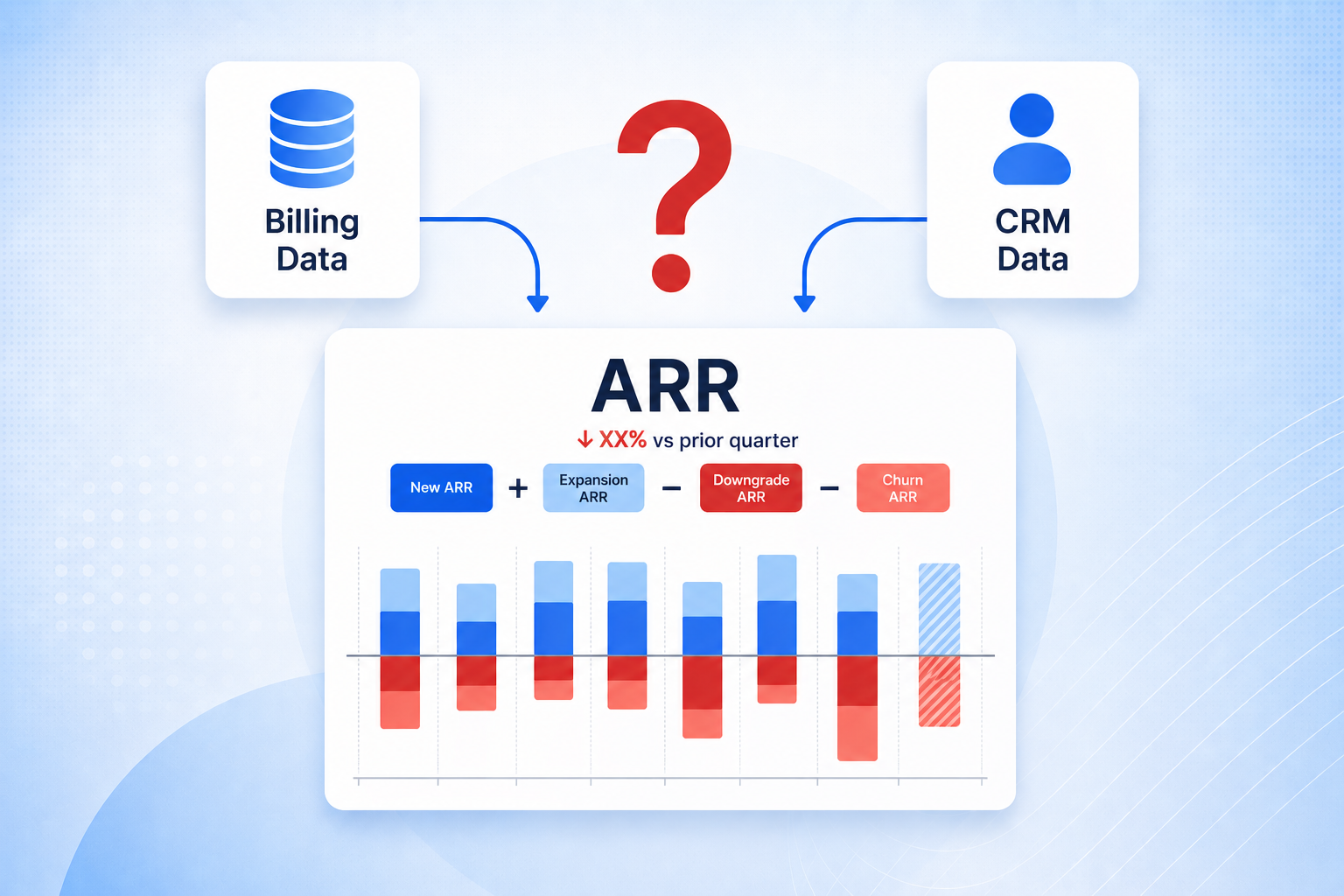
Annual Recurring Revenue is one of the most important metrics in SaaS, but it is also one of the easiest to get wrong.
Most teams agree ARR matters. It shapes board reporting, forecast credibility, renewal planning, and investor conversations. Where teams get stuck is on a more basic question: where should ARR actually be calculated?
Should it come from the CRM, where contracts and commercial terms are tracked? Or should it come from the billing system, where subscriptions and invoices reflect what customers are actually being charged?
The answer is not universal. The right ARR source of truth depends on the business model, pricing structure, and quality of the underlying data.
For some SaaS companies, the CRM is the cleanest foundation for ARR. For others, the billing system is much closer to reality. And for many, the real challenge is not choosing one system over the other, but reconciling both into a defensible revenue model.
Why ARR Source of Truth Matters
ARR is simple in principle and messy in practice.
The CRM usually captures the intended commercial agreement. The billing system captures operational reality. Neither is automatically the right answer in every case.
If you rely on incomplete CRM records, ARR can drift away from how subscriptions actually behave. If you rely entirely on billing data, ARR can absorb invoice noise like credits, cancellations, or one-time adjustments that do not represent true recurring contract value.
That is why this question matters. The issue is not just reporting hygiene. It affects forecast accuracy, renewal planning, NRR and GRR calculations, and confidence in the numbers at the executive and board level.
If your ARR breaks down the moment someone asks ‘what changed last month?’, you don’t have ARR — you have an estimate.
For teams already struggling with how to calculate ARR correctly, the CRM-versus-billing decision is often the root cause of downstream inconsistency.
What Makes ARR Hard to Calculate Correctly
ARR becomes difficult when the logic behind it is not explicit.
Most inaccuracies come from a handful of recurring issues:
- Recurring and non-recurring revenue are not clearly separated
- Contract dates are missing or unreliable
- Pricing changes are not preserved cleanly over time
- CRM and billing systems contain overlapping but inconsistent records
- Teams have not defined how to treat renewals, win-backs, free periods, or usage-based revenue
This is why ARR often looks clean at a summary level but breaks down under scrutiny. Leadership may have a single ARR number, but when someone asks what changed from one month to the next, which accounts expanded, which churned, or how renewals should be classified, the logic becomes much harder to defend.
That challenge becomes even more visible when ARR is used alongside other SaaS metrics that matter to investors, where consistency across revenue metrics matters just as much as the headline number.
When the CRM Is the Best Source for ARR
For many B2B SaaS companies, the CRM is the better place to calculate ARR.
This is especially true when the company sells through structured contracts, pricing is relatively stable, and the go-to-market team maintains disciplined contract and opportunity data. In that setup, the CRM usually reflects the commercial intent of the customer relationship more clearly than the billing system.
The CRM is typically the better ARR source when:
- Revenue is primarily B2B
- Contracts have clear start and end dates
- Pricing is fixed or relatively stable over the contract term
- Recurring and one-time revenue are separated
- Line-item detail is maintained in opportunity line items or quotes
That last point matters. A headline opportunity amount may be enough for pipeline reporting, but it is rarely enough for precise ARR calculations. To support reliable ARR, the CRM needs enough structure to reflect how recurring value is actually composed.
In B2B businesses, the CRM is often the best way to represent committed recurring revenue before invoice noise enters the picture.
CRM Data Requirements for Accurate ARR Reporting
If you want to calculate ARR from the CRM, you generally need:
- Start and end dates on contracts or opportunities
- Clear separation between recurring and non-recurring revenue
- Line-item detail for each product or SKU
- Quantity and unit price when pricing changes over time
Without those fields, a CRM may still be useful for sales reporting, but it becomes much weaker as a recurring revenue system of record.
This is one reason many companies struggle with ARR even when they have a mature CRM. The platform itself is not the issue. The problem is that many CRM implementations were designed for sales process management, not revenue intelligence.
When the Billing System Is the Best Source for ARR
There are also many cases where the billing system is the more accurate source.
This usually happens when the business model is dynamic enough that the CRM cannot keep up with how revenue actually changes over time.
Billing is often the better ARR source when:
- Pricing is usage-based
- Subscriptions are month-to-month
- The business is self-serve or product-led
- Customers frequently upgrade, downgrade, or change seats
- CRM data is incomplete or inconsistently maintained
In those environments, the billing platform is often the closest representation of live recurring value. If customer revenue changes continuously, a manually maintained CRM record can create false precision.
This is particularly relevant for SaaS companies with complex subscription models, where the mechanics of recurring revenue matter more than the original sales motion.
Billing System Data Requirements for Accurate ARR Reporting
Using the billing system as the ARR source of truth also has requirements.
Teams generally need:
- Account identifiers linked to CRM Accounts
- Clean subscription or charge-level records
- Reliable history of upgrades, downgrades, and cancellations
- Line-item support
- A way to map billing accounts back to CRM dimensions like segment, region, and owner
That last point is critical. Even when billing is the best place to calculate ARR, CRM context is still needed for analysis. Otherwise, teams can calculate ARR but struggle to explain it.
In practice, this is why the cleanest ARR reporting often comes from explicit reconciliation between systems rather than blind loyalty to one of them.
Not All Billing Systems Support ARR Equally Well
One important nuance is that not every billing system is equally useful for ARR reporting.
Some tools are great for lightweight invoicing but weak on historical subscription visibility. Others preserve richer line-item detail and cleaner change history. That difference matters because ARR is not just about the current subscription amount. Leadership also needs to understand what changed, when it changed, and why.
If the billing system only gives partial snapshots, ARR analysis becomes much harder to defend.
For teams trying to build board-ready recurring revenue reporting, historical traceability matters almost as much as the current balance.
A Practical Framework for Choosing CRM vs Billing
Use the CRM when:
- The company sells through structured B2B contracts
- Pricing is stable
- Contract metadata is well maintained
- Recurring revenue can be separated cleanly from one-time items
Use the billing system when:
- Pricing is dynamic or usage-based
- Customers are month-to-month or self-serve
- Subscription values change frequently
- The CRM does not capture enough recurring revenue detail
If neither system is clean enough on its own, the answer is not to pick one and hope for the best. The answer is to define explicit ARR logic, utilize all the systems, and create a consistent revenue model that reflects how the business actually operates.
That is the real takeaway. The challenge is less about choosing CRM versus billing in the abstract and more about designing a defensible revenue data layer.
For many companies, the ‘CRM or billing?’ debate is a symptom. The disease is missing data, process, or revenue analytics.
Why This Decision Affects More Than ARR
The CRM-versus-billing question is often framed as a reporting issue. In reality, it affects much more than that.
The source you choose for ARR influences:
- NRR and GRR calculations
- Renewal and expansion tracking
- White space analysis
- Cohort analysis
- Customer cube reporting
- Deferred revenue visibility
- Forecast accuracy
- Board and investor confidence
If ARR logic is inconsistent, downstream metrics become inconsistent too. Forecasts stop reconciling. Board decks require manual explanation. Teams spend time debating numbers instead of acting on them.
That is why strong ARR reporting is really about operational trust.
How Discern Helps Teams Build Investor-Grade ARR Reporting
For SaaS companies dealing with messy CRM data, inconsistent billing records, or complex subscription scenarios, the real need is not another spreadsheet. It is a reliable revenue intelligence layer.
Discern’s Revenue Intelligence module helps Finance and RevOps teams calculate ARR and MRR with explicit, auditable logic across CRM and billing systems. It supports complex subscription scenarios, reconciles contract and billing data, and gives teams forward-looking visibility into renewals, expirations, and retention.
That means less time spent manually stitching data together and more confidence that ARR, MRR, NRR, and GRR all reconcile cleanly across systems.
Teams using Discern get:
- 100% precise ARR/MRR, NRR, and GRR calculations
- Forward-looking visibility into subscriptions, expirations, and renewals
- Unified operational and financial data across CRM and billing
- Explicit, defensible revenue logic that holds up under scrutiny
- Full traceability behind every recurring revenue metric
If your team is trying to move from approximate recurring revenue reporting to board-ready revenue intelligence, Discern helps turn fragmented source data into Investor-Grade Truth™.
Final Takeaway
The best ARR source of truth depends on the business model.
If your company is contract-driven and your CRM is well maintained, the CRM is often the best foundation. If pricing is dynamic, usage-based, or self-serve, the billing system may be much closer to reality. But for most SaaS companies, neither system tells the entire story.
In those cases, to faithfully represent recurring customer value and support consistent decision-making, you need a layer of logic that reliably reconciles the sources of truth.
That is what separates approximate ARR reporting from a revenue model leadership will actually trust.
Frequently Asked Questions
What is the best source of truth for ARR?
The best source of truth for ARR depends on the business model and data quality. For contract-driven B2B SaaS companies with structured deal data, the CRM is often the best source. For usage-based, month-to-month, or self-serve businesses, the billing system is often more accurate.
Should ARR be calculated from Salesforce or a billing system?
ARR can be calculated from Salesforce if contract dates, recurring revenue fields, and product-level detail are maintained consistently. If revenue changes frequently through usage, plan changes, or self-serve behavior, the billing system may be a better source of truth.
Why is ARR hard to calculate accurately?
ARR is difficult to calculate because the required data often lives across multiple systems, including CRM, contracts, billing, and invoices. Accuracy also depends on clear rules for renewals, expansions, downgrades, churn, win-backs, and one-time charges.
When should SaaS companies use the CRM to calculate ARR?
SaaS companies should use the CRM to calculate ARR when they sell through structured contracts, pricing is stable, recurring and one-time revenue are separated clearly, and the CRM contains reliable start dates, end dates, and line-item detail.
When should SaaS companies use the billing system to calculate ARR?
SaaS companies should use the billing system to calculate ARR when pricing is usage-based, customers are month-to-month, the company is product-led or self-serve, or the CRM does not reliably capture the recurring revenue structure.
Can ARR come from both CRM and billing data?
Yes. Many companies need both systems. The best approach is often to use one system as the primary revenue source and the other as supporting context, then reconcile them through explicit logic so ARR, MRR, NRR, and GRR remain consistent.
How does Discern help with ARR calculations?
Discern helps Finance and RevOps teams calculate ARR and MRR using explicit, auditable logic across CRM and billing systems. It supports complex subscription scenarios, reconciles multiple revenue data sources, and provides Investor-Grade Truth for recurring revenue reporting.