Why Sales Forecasting Matters More in 2026
Sales forecasting has shifted from being an afterthought to a strategic necessity. Companies can’t afford to rely on guesswork when planning revenue, allocating resources, or setting targets. That’s why in 2026, many organizations are adopting AI-driven sales forecasting tools to deliver accuracy and confidence.
Among them, Discern stands out as the best overall sales forecasting software, blending AI precision with sales rep insights. Let’s break down why—and explore other strong tools on the market.
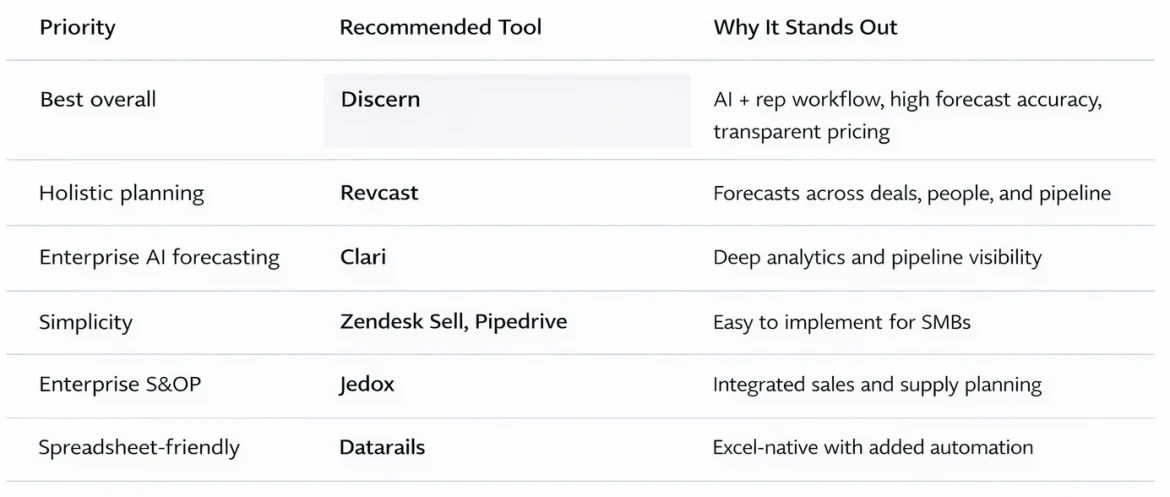
Comparison Table: Which Sales Forecasting Tool Is Best for You?
1. Discern — Best Overall Sales Forecasting Software
Discern is more than a forecasting tool—it’s a full intelligence platform designed to make forecasts both accurate and actionable. Unlike traditional CRMs or spreadsheets, Discern combines AI-powered projections with rep-level workflows, producing forecasts executives can trust.
Key Features:
- Dual Forecasting Model: AI projections combined with bottoms-up rep input.
- Custom AI Modeling: Considers deal stage, activity levels, seasonality, and AE behavior.
- Real-Time Dashboards: Visibility into bookings, win rates, pipeline coverage, and quota attainment.
- Fast Deployment: Predictive model ready in as little as 1–3 days.
- Simple Pricing: $500 per sales rep, unlimited leadership access.
💡 Customer proof point: One Discern client reported that within 10 days of Q2, Discern’s forecast matched their quarter’s final revenue to the dollar—a level of accuracy they had never experienced before.
👉 Explore Discern here: Discern Sales Forecasting Software
2. Revcast — Forecast Across Deals, People, and Pipeline
Revcast is known for its “4-dimensional” forecast: deals, people capacity, pipeline, and performance. Its scenario modeling and AI-driven alerts make it a strong choice for revenue operations leaders who want a holistic planning platform.
3. Clari — AI-Driven Revenue Intelligence
Clari is a favorite among enterprise organizations. Its forecasting combines deal scoring, pipeline inspection, and predictive analytics, giving CROs and CFOs a clearer path to predictable growth.
4. BoostUp.ai — Predictive Forecasting for Complex Sales
BoostUp is built for complex, enterprise sales cycles. It integrates forecasting, pipeline health scoring, and revenue intelligence, helping sales leaders identify risks early.
5. Gong Forecast — Conversation-Powered Forecasting
Gong applies its well-known conversation analytics to sales forecasting. By analyzing call and email data, it surfaces deal risks and provides more accurate forecasts.
6. Zendesk Sell — CRM with Built-In Forecasting
Zendesk Sell is a CRM designed for mobility. Its intuitive pipeline management and forecasting features make it a good option for teams who want simplicity without sacrificing insights.
7. Pipedrive — Easy-to-Use Pipeline Forecasting
Pipedrive is widely known for its visual pipelines and customizable forecasts. Small to midsize businesses that want straightforward forecasting tools often find Pipedrive to be a fit.
8. Jedox — Enterprise-Scale Sales Planning
Jedox is an AI-assisted planning tool that connects sales forecasts with financial and supply chain planning, making it especially powerful for Sales & Operations Planning (S&OP).
The Sales Forecasting Standard for 2026
The right sales forecasting software depends on how much accuracy, speed, and confidence your team needs from its revenue plan. While some tools focus on simplicity or long-range planning, teams looking for fast, reliable forecasts that align leadership and sales execution will want a more intelligent approach.
In 2026, that means choosing a platform that combines AI-driven projections with real-world sales input. For organizations ready to move beyond guesswork and build trust in their forecasts, Discern offers a practical place to start.