RevOpsSaaS RevOps AI Agents12 min read

Reliable business decisions and AI effectiveness depend on trusted data across various systems. Organizations often face discrepancies in customer and revenue data, complicating reporting and operational functions. A robust data quality project should focus on understanding root causes, reconciling systems, and creating a governed data foundation to support actionable insights.
CPQ systems are designed to produce valid quotes. They apply product rules, calculate prices, enforce discount limits, and route exceptions for approval. But a quote can follow every rule and still be the wrong commercial decision.
To determine whether a quote is actually good, sellers and Deal Desk need business context: who the customer is, what they need, and how comparable customers have bought. Bringing that context into the quoting workflow helps teams build more relevant offers, identify missing products, structure stronger terms, and avoid leaving value on the table.
A quote can be technically correct and commercially weak.
It may contain eligible products. The math may be accurate. The discount may fall within the seller’s authority. Every required field may be complete.
But none of that answers the questions that matter most:
Traditional CPQ is effective at enforcing rules. It is less effective at evaluating the business context surrounding a quote.
That context is what turns quoting from a configuration exercise into a commercial decision.
Most quoting systems begin with the product catalog.
The seller selects a package, enters quantities, adds services, chooses a term, and applies a discount. The system checks the proposed quote against predefined rules. If something falls outside policy, the quote moves into an approval workflow.
This process can prevent invalid configurations and unauthorized discounts. But it places much of the commercial judgment on the seller.
The seller has to know which products fit the customer’s situation. They have to remember what was discussed across discovery calls, emails, demonstrations, and internal conversations. They may also need to judge whether the proposed price and terms are reasonable without being able to see how similar deals were structured.
The information exists, but it is often scattered across systems:
When that information is not available at the point of quoting, sellers work from a limited dataset. They quote what they remember, what the customer requested most recently, or what is easiest to configure.
A context-aware quoting process should bring together three categories of information.
1. Who Is the Customer?
The first layer is firmographic and operational context.
This includes what the company already knows about the account:
These details affect what the customer is likely to need and how the offer should be structured.
A multinational financial services company may require different security, support, and data residency options than a smaller domestic software company. A rapidly growing customer may benefit from a pricing structure that accommodates expansion. A regulated organization may need implementation or compliance services that another customer would not require.
Without this context, product selection depends heavily on the seller’s familiarity with the catalog and their ability to connect customer characteristics to the right offer.
With it, the quoting system can make a more informed recommendation:
This customer operates in the United States and Europe, has 1,500 employees, and works in a regulated industry. Include the enterprise security package and premium support. Confirm data residency requirements before finalizing the quote.
The system is not inventing an offer. It is applying the company’s product and commercial knowledge to the customer’s situation.
2. What Does the Customer Need?
Account attributes explain who the customer is. Conversation context explains why they are buying.
Customer needs are rarely captured in one perfectly structured field. They emerge over time through:
A customer may mention that implementation speed is important during one call, describe a reporting problem in an email, and ask about international support during a later demonstration. Each interaction adds to the commercial picture.
If those needs are not carried into the quote, the seller may configure only the products explicitly requested at the end of the process.
That creates two risks.
First, the quote may be incomplete. A relevant product, service, or support package may be omitted even though the customer described a clear need for it.
Second, the quote may feel generic. It lists products and prices without showing that the seller understood the customer’s priorities.
A context-aware workflow can assemble the customer’s requirements and compare them with the proposed configuration:
The customer identified implementation capacity, regional data controls, and executive reporting as priorities. The current quote includes the core platform and data residency but does not include implementation services or advanced reporting. Review both before sending.
This gives the seller a chance to correct an omission while the quote is still being built.
It also creates a more relevant customer experience. The quote reflects what the customer said, not just what the catalog contains.
3. What Happened in Comparable Deals?
The third layer is commercial context from similar customers and transactions.
A quote should not be evaluated in isolation. The company already has evidence from previous deals, including:
The most useful comparisons are not necessarily every deal in the CRM. They are deals involving customers with relevant similarities, such as industry, size, region, use case, product mix, or buying motion.
Consider two quotes that both include a 20 percent discount.
One may be reasonable because similar customers received the same discount in exchange for a three-year prepaid agreement. The other may be unnecessarily aggressive because comparable customers bought at a 10 percent discount on annual terms.
The discount field alone cannot explain the difference. Comparable-deal context can.
A seller or Deal Desk reviewer should be able to see something like:
| Decision factor | Current quote | Comparable deals |
| Contract term | 12 months | Most similar customers: 24–36 months |
| Discount | 20% | Typical range: 10–15% |
| Support | Standard | Similar enterprise customers: Premium |
| Implementation | Not included | Included in most comparable first-year deals |
| Payment terms | Net 60 | Typical: Net 30 |
This does not mean historical deals should dictate the answer. Every customer and negotiation is different.
The comparison provides a reference point. It shows where the quote departs from precedent so the seller can decide whether the difference is justified.
Without context, Deal Desk often reviews a quote against policy:
These questions are important, but they are defensive. They help prevent mistakes.
Business context allows Deal Desk to ask more valuable questions:
The approval itself becomes more useful. Instead of receiving a discount percentage and an Approve button, the reviewer gets the information needed to make a decision.
The requested 20 percent discount is five points above the typical range for similar customers. Comparable deals at this level used three-year terms. Consider offering 15 percent for one year or 20 percent for three years before requesting approval.
This moves Deal Desk from exception processing to deal optimization.
Business context should not be used only to increase price.
Its purpose is to improve the fit between the customer’s needs and the commercial offer.
For the customer, that can mean:
For the seller and the company, it can mean:
The strongest quote is not necessarily the quote with the highest price or the lowest discount. It is the quote that creates the right exchange of value for the customer and the company.
It is not enough for customer and deal information to exist somewhere in the organization.
A seller working on a quote is unlikely to stop and manually search through call transcripts, email threads, old contracts, CRM reports, and previous opportunities. Deal Desk may not have time to reconstruct that context during every approval.
The information has to appear inside the decision workflow.
When a seller starts a quote, the system should be able to:
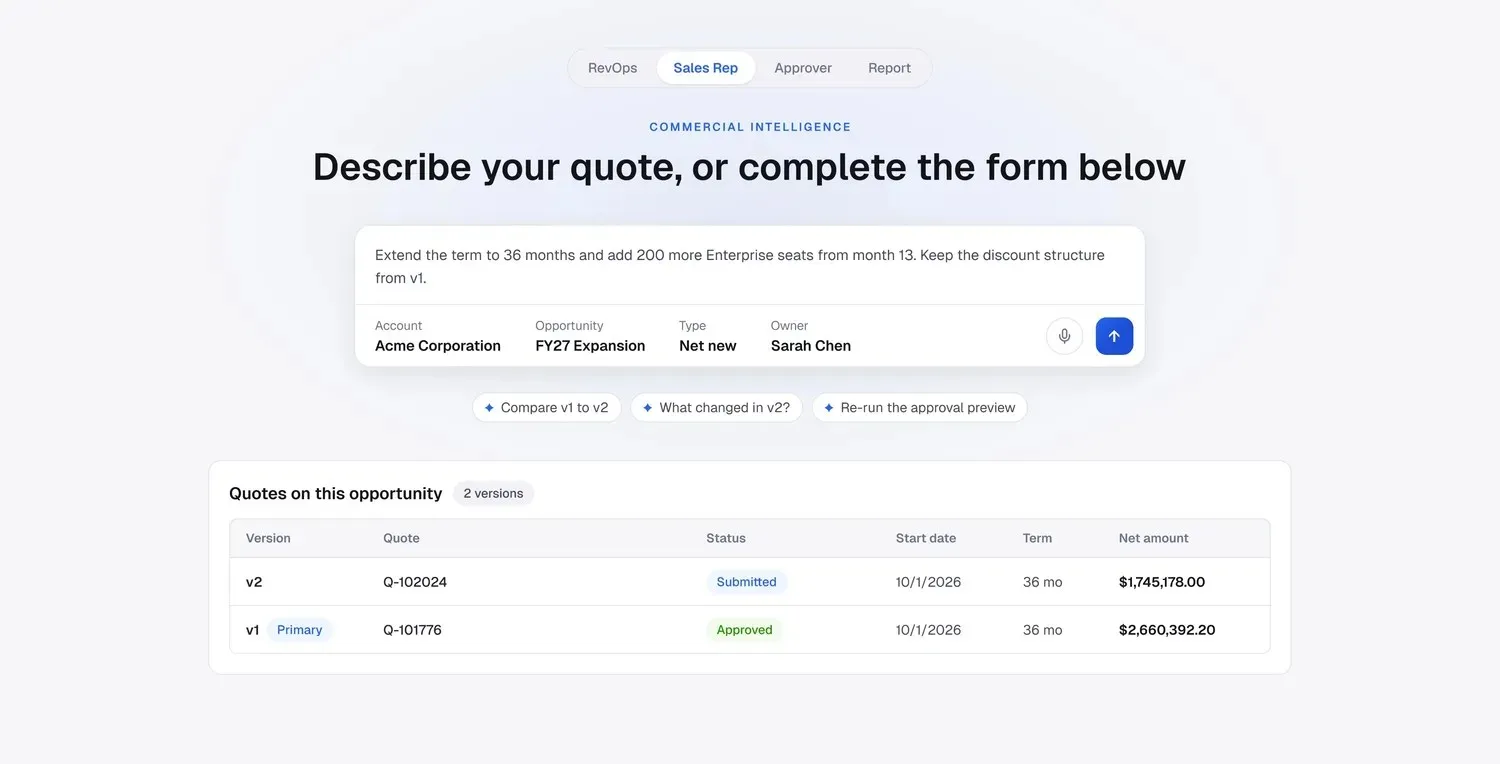
This is where AI-native quoting can move beyond making CPQ easier to operate. AI can assemble the commercial context around the transaction and use it to support a better decision, while governed product, pricing, and approval rules keep the resulting quote controlled and reviewable.
Traditional CPQ answers an important question:
Can we sell this configuration at these terms?
Context-aware quoting answers a broader one:
Should we sell this configuration at these terms, to this customer, given what we know?
That distinction matters.
A seller should not have to rely on memory to identify a missing product. Deal Desk should not have to judge an exception without comparable transactions. The company should not have to discover after signature that it offered more discount, a shorter term, or fewer products than the opportunity justified.
A good quoting system should understand the catalog and the customer. It should enforce policy and inform judgment. It should help the seller create an offer the customer recognizes as relevant while helping the company protect and capture value.
That is the opportunity behind Commercial Intelligence: bringing customer, conversation, and comparable-deal context into the moment when commercial decisions are made.
A valid quote follows the rules.
A good quote reflects the business.

Join 30+ B2B software companies and PE firms that trust Discern for automated, board-ready analytics.
Book a Demo


4.8/5 100+ Reviews
Trusted by the world leaders