Revenue IntelligenceRevOpsSaaS RevOps AI Agents9 min read

Manually picking products, quantities, start dates and terms isn’t where reps add value. AI can build the quote so sales can focus on negotiation.
Sales teams need to understand customers, negotiate terms, and close deals. But do they need to manually assemble every quote? With the right customer context, product rules, pricing policies, and company objectives, AI can generate a complete quote for review. The opportunity goes beyond saving time: it is to create stronger offers that meet customer needs while protecting the company’s commercial interests.
A customer is ready for a proposal.
The sales rep opens the quoting system, searches the product catalog, selects products, enters quantities, chooses start dates, sets contract terms, and adjusts pricing. They check whether services are required, whether a discount applies, and whether a multiyear agreement needs annual price increases.
Much of this work involves translating what the company already knows into fields.
The customer’s requirements have been discussed. The products and prices are defined. The company has policies governing what can be sold together and under which terms.
Why should the rep have to reconstruct all of that manually?
Sales should own the customer relationship and the commercial negotiation. AI should be able to assemble the quote that supports them.
In our previous article, A Valid Quote Is Not Always a Good Quote: Why Business Context Matters in CPQ, we explored how customer information, sales conversations, and comparable deals help teams evaluate an offer.
That same context can become the starting point for quote creation.
AI can bring together:
Initially, this information can help AI review an existing quote. It might identify a missing service, recommend a relevant product, or flag a discount that appears unnecessarily aggressive.
The next step is to generate the first quote directly from that context.
The rep could ask:
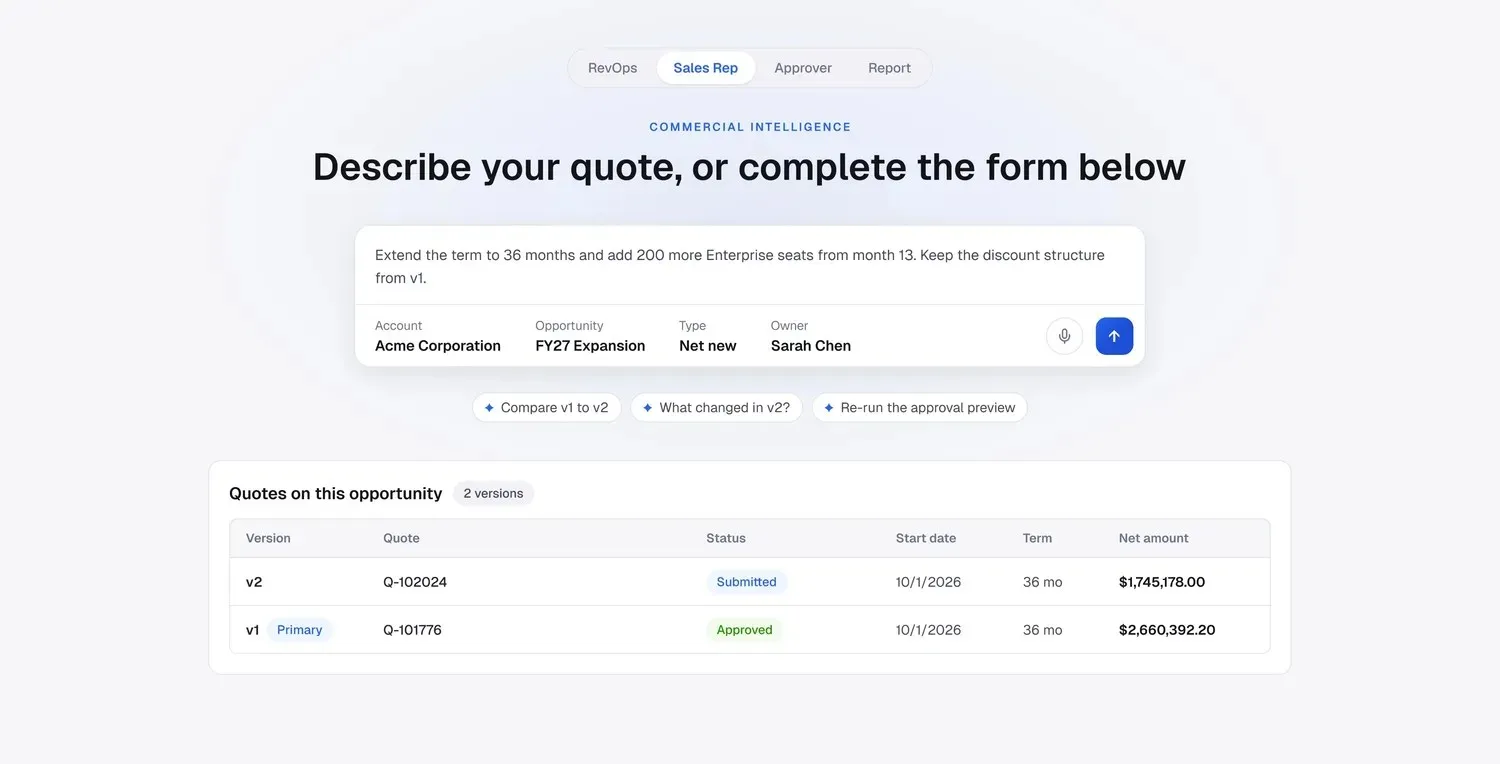
Prepare a quote for this opportunity using the customer’s requirements and our current commercial policies. Explain the proposed products, pricing, and terms, and flag anything that still needs confirmation.
Instead of starting with an empty form, the rep starts with a complete proposal to evaluate.
Context helps AI determine what the customer needs. Governed rules determine how the offer can be constructed.
Both are necessary.
If selling a particular product requires another product or service, the generated quote should include that dependency automatically.
An enterprise package might require implementation services. An add-on might depend on a core subscription. A particular deployment option might require a specific support tier.
The rep should not have to remember every dependency across the catalog.
AI can recommend the configuration, while the quoting system validates it against the company’s approved product rules. The resulting quote should explain which components are required and which are optional recommendations.
If a published pricing rule grants a discount above a certain quantity or purchase amount, that discount should be reflected automatically.
The rep should not need to find the threshold, calculate the adjustment, and enter it manually.
There is also an important distinction between a contractual or published discount and a discretionary concession.
An automatic volume discount should follow the approved pricing schedule. An additional negotiated discount should depend on commercial justification and the appropriate authority.
Being eligible to offer a concession does not mean every deal should start with the maximum concession available.
If company policy calls for annual price increases on multiyear agreements, those increases should be included when the quote is created.
For fixed increases, the quote can show the price for each contract year. For CPI-linked increases, it should apply the approved formula, timing, and any caps or floors. Future amounts that depend on an unpublished index should be clearly identified.
This makes the pricing structure visible during negotiation and reduces the chance that an intended increase disappears from the final offer.
Accurate configuration and faster preparation are valuable. But the most significant opportunity is to make company objectives part of the quote from the beginning.
Today, commercial priorities often reach Sales through training, presentations, or reminders:
Cross-sell this product. Protect margin. Reduce unnecessary discounts. Encourage longer commitments.
The rep then has to remember those priorities and decide how to apply them to each opportunity.
With AI-generated quoting, administrators can define those objectives directly.
| Company objective | How it can shape the initial quote |
|---|---|
| Increase adoption of a product in a target segment | Recommend it when the account fits the segment and the product addresses a documented need |
| Minimize unnecessary discounting | Start with approved pricing and use deal context to justify concessions |
| Encourage multiyear commitments | Present a longer-term option with clear customer benefits and appropriate annual increases |
| Protect margin | Evaluate the economics of the proposed products, services, and terms |
| Support expansion | Recommend a structure that accommodates the customer’s expected growth |
These objectives should guide recommendations within product, pricing, and approval rules.
They should also be considered together. A cross-sell target should not produce an irrelevant bundle. A preference for longer contracts should account for the customer’s willingness to commit. Protecting price should be balanced with the opportunity to win a valuable customer.
When objectives conflict, AI should explain the tradeoff and present alternatives for the seller to review.
Consider a customer evaluating a three-year agreement.
The sales conversations establish an initial requirement for 500 users, an implementation deadline, and a need for advanced reporting. Company policy requires onboarding services, provides a volume discount at 500 users, and includes annual price increases. The company also wants to increase adoption of its reporting product within this customer segment.
AI can assemble a quote that:
The rep can then evaluate whether the proposal reflects the customer’s priorities and use it as the basis for negotiation.
If the customer asks for a lower first-year price, AI can help compare alternatives: a phased rollout, a different package, or a concession tied to a longer commitment.
The seller spends time deciding what to offer and what to ask for in return.
Manual quote preparation consumes time that could be spent understanding objections, aligning stakeholders, and negotiating an agreement.
It also creates repeated work. A change in quantity or contract length can require another round of configuration, calculations, and checks.
AI can regenerate the proposal as the negotiation develops, showing what changed and how those changes affect the deal.
Sales still reviews the offer, confirms assumptions, and applies judgment. Required exceptions still follow the company’s approval process.
But the rep no longer has to operate every field to move the deal forward.
Sales teams need to own the deal. They should not need to manually assemble every quote.
With customer context, governed commercial rules, and explicit company objectives, AI can create an informed starting offer and help refine it throughout the negotiation.
The goal is a quote that addresses the customer’s needs, supports the seller’s ability to win, and captures appropriate value for the company.
Faster quote creation matters. Starting with a stronger deal matters even more.
Yes, when it has sufficient customer and opportunity context, access to an approved product catalog, and defined pricing and commercial rules. Missing or conflicting information should be flagged for confirmation.
It can use sales conversations, emails, account information, and relevant past deals to identify requirements and recommend a configuration. Product dependencies and eligibility rules determine which combinations are valid.
Yes. Administrators can define priorities such as relevant cross-selling, margin protection, reduced discounting, or longer commitments. AI can use those priorities to construct and compare offers within approved policies.
Sales remains responsible for confirming that the offer fits the customer and supports the negotiation. AI prepares the quote and explains its recommendations; sellers and approvers apply judgment where needed.

Join 30+ B2B software companies and PE firms that trust Discern for automated, board-ready analytics.
Book a Demo


4.8/5 100+ Reviews
Trusted by the world leaders