Revenue IntelligenceRevOpsSaaS RevOps AI Agents6 min read
See how AI native CPQ replaces legacy screens with conversational quoting, bundle creation, pricing rules, approvals, and deal optimization.
CPQ was built to bring control to complex selling. It gave companies a structured way to configure products, calculate prices, generate quotes, and route exceptions for approval.
The control still matters. The traditional CPQ application does not have to remain.
Most CPQ products ask sellers to translate a customer conversation into a sequence of searches, screens, fields, product codes, configuration steps, and approval actions. Administrators face a similar burden behind the scenes. They build bundles in one area, pricing logic in another, and approval workflows somewhere else. Small policy changes can require specialized knowledge, testing, and deployment work.
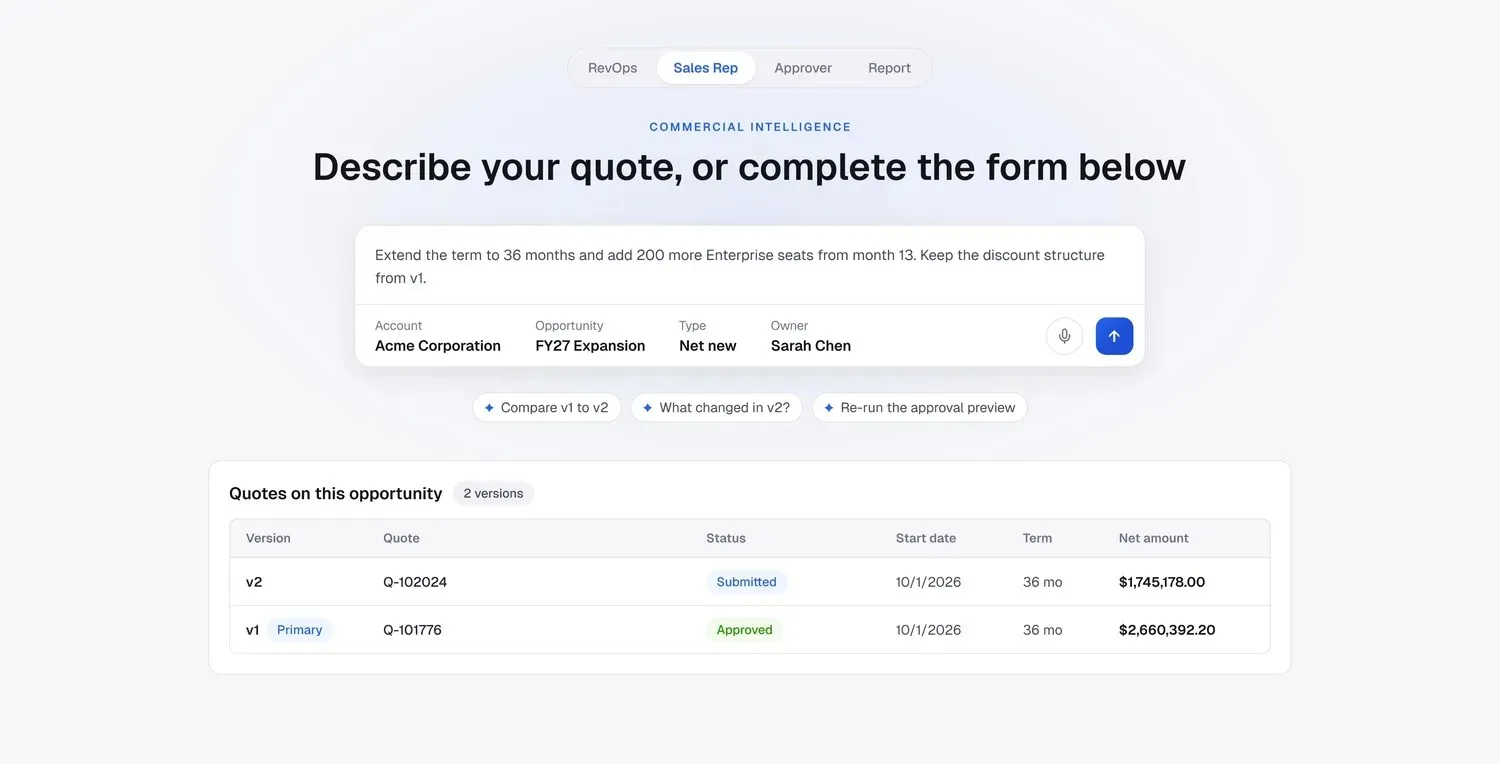
An AI native system can replace that experience. A seller describes the deal and receives a valid, editable quote. An administrator describes a product bundle, price rule, or approval policy and receives a structured, editable configuration. Governed commercial logic still controls the result, but users no longer have to operate conventional CPQ software to create or maintain it.
The result is a shorter path from customer need to approved quote, with much less searching, clicking, and system navigation.
A moderately complex quote can force an account executive to complete a long chain of system tasks before the customer sees a price.
The seller already understands the customer’s request. The work comes from translating that request into the structure the application expects.
We need 500 Enterprise licenses for three years, Premium Support, and implementation. Show me the best price I can offer without requiring an exception.
A traditional workflow breaks that request into many separate actions. An AI native workflow treats the request as the starting point. The system identifies the eligible products, applies the relevant commercial logic, and returns a complete quote for review.
The seller begins with the customer’s requirements rather than the application’s navigation model.
Create a three-year quote for 500 Enterprise licenses. Add Premium Support and implementation. Apply the best discount within my authority.
The system translates the request into a governed quote and presents the result in an editable table.
| Product | Quantity | Term | Discount | Approval |
|---|---|---|---|---|
| Enterprise license | 500 | 36 months | 15% | Within authority |
| Premium Support | 1 | 36 months | None | Not required |
| Implementation | 1 | One time | None | Not required |
The seller can edit the table directly or continue the conversation.
Each instruction updates the same structured deal. The seller does not need to search for a field, reopen a configurator, or remember where a setting lives.
Replacing traditional CPQ requires more than a better seller interface. The administration experience also needs to change.
Today, a CPQ administrator may need to create product records, assemble bundle relationships, configure option constraints, write price rules, maintain lookup tables, define approval conditions, and test the result across several administrative screens. The work is precise, but the interface often makes the administrator express a business policy as a collection of technical settings.
In an AI native system, the administrator starts by describing the commercial policy it wants to create. AI converts that description into structured logic, shows the result for review, identifies conflicts or missing conditions, and allows edits before publication.
Create an Enterprise Security bundle with 500 or more platform licenses, SSO, advanced audit logs, and Premium Support. Include implementation by default. Make data residency optional and limit it to eligible regions.
AI can create the bundle structure, associate the eligible products, define required and optional components, add quantity constraints, and calculate the initial bundle price. The administrator then reviews the result in a structured editor.
| Component | Status | Pricing method | Constraint |
|---|---|---|---|
| Platform licenses | Required | Per user | Minimum 500 |
| SSO | Required | Included | Enterprise tier |
| Advanced audit logs | Required | Included | Enterprise tier |
| Premium Support | Required | Percentage of subscription | All bundle terms |
| Implementation | Default selection | One time | May be removed with approval |
| Data residency | Optional | Annual add on | Eligible regions only |
The administrator can edit any row, ask for a different pricing method, add a dependency, or tell AI to run test configurations. AI should explain the proposed change and preserve a version history before the bundle is published.
For Enterprise subscriptions, apply a 5 percent volume discount at 500 users and 10 percent at 1,000 users. Add another 3 percent for a three-year prepaid agreement. Cap the combined automatic discount at 15 percent.
AI can translate the policy into explicit conditions, calculations, precedence, and caps. It can also flag ambiguity before the rule takes effect. For example, it should ask how to handle a customer that qualifies for an existing negotiated price or whether the term discount applies to annual billing.
| Condition | Adjustment | Limit or precedence |
|---|---|---|
| 500 to 999 users | 5% volume discount | Automatic |
| 1,000 or more users | 10% volume discount | Replaces 5% tier |
| 36 month term and prepaid | Additional 3% | Stacks with volume discount |
| Combined automatic discount | Maximum 15% | Approval above cap |
The administrator can modify the generated rule in plain language or through the structured view. The system can simulate representative transactions and show which rule fired, what price it produced, and whether another rule changed the outcome.
Route discounts above 15 percent to the sales manager. Add Finance when gross margin falls below 70 percent. Add the VP of Sales when total contract value exceeds $1 million. Run Finance and VP review in parallel when both conditions apply.
AI can create the conditions, identify the approver roles, define parallel or sequential routing, and show the administrator a readable workflow before activation.
| Trigger | Approver | Routing |
|---|---|---|
| Discount above 15% | Sales manager | First required review |
| Gross margin below 70% | Finance | After manager unless parallel condition applies |
| TCV above $1 million | VP of Sales | Parallel with Finance when both trigger |
The administrator can test the workflow against sample deals, revise a threshold, change the routing order, or add an escalation deadline. Before publishing, the system should surface unreachable branches, conflicting conditions, missing approvers, and changes that could increase approval volume.
The replacement is clearest when both sides of the workflow are considered together.
| Traditional CPQ work | AI native replacement |
|---|---|
| Search catalogs and select product codes | Describe customer requirements and review a proposed configuration |
| Move through configuration screens | Edit the generated quote in a table or through conversation |
| Change fields to test pricing scenarios | Ask for alternatives and compare the commercial result |
| Open multiple records to understand an approval | Receive the reason, economics, and recommendation in one decision view |
| Build bundles across product and option screens | Describe the bundle and review generated products, dependencies, and pricing |
| Translate pricing policy into technical rules | Describe the policy and edit the generated conditions and calculations |
| Construct approval logic node by node | Describe triggers and routing, then test the generated workflow |
| Trace errors through configuration metadata | Ask why a result occurred and inspect the rule and source data |
The system of record still stores products, prices, policies, permissions, quote versions, and approvals. What changes is how people create, inspect, and act on that information. AI replaces the menus and screens as the primary operating model.
Large catalogs make product knowledge a prerequisite for quoting. New sellers often need help from Sales Operations, Solution Consulting, or Deal Desk to identify the correct package, support level, or service.
The customer has 1,200 employees in the United States and Europe. They need SSO, advanced security, data residency, and 24 hour support. Recommend an eligible package.
The system can map those requirements to the administrator-defined catalog and return a valid recommendation. It should also explain why each component was included and identify any unanswered questions that affect eligibility.
AI does not need to invent the offer. It uses the product definitions and constraints created through the administrator workflow. This connects easier administration directly to easier selling.
Traditional CPQ can calculate a price accurately while still making pricing decisions difficult. A seller may know what the customer asked for but not what authority applies, how another two percentage points affect margin, or whether a longer term creates a better option.
Compare this deal at 10, 15, and 20 percent discounts. Show ARR, TCV, margin, and required approval.
| Scenario | Discount | ARR | TCV | Margin | Approval |
|---|---|---|---|---|---|
| Standard | 10% | $XXX | $XXX | XX% | AE |
| Competitive | 15% | $XXX | $XXX | XX% | Manager |
| Aggressive | 20% | $XXX | $XXX | XX% | VP |
The seller can compare the options before submitting anything. Deal optimization can then recommend a structure grounded in the company’s policy and available commercial context.
The requested 20 percent discount requires VP approval. A 15 percent discount with a three-year prepaid term remains within the target margin and requires manager approval. Review both options before sending.
This moves the system beyond validation. It helps the seller construct a stronger deal while keeping the decision transparent.
Managers rarely struggle to find an Approve button. They struggle to understand why the request reached them and whether the exception makes sense.
An AI native approval view can assemble the relevant facts and answer follow-up questions without forcing the manager to open the opportunity, account, quote, and pricing records separately.
| Decision factor | Current quote |
|---|---|
| ARR | $425,000 |
| Contract term | 36 months |
| Requested discount | 18% |
| AE authority | 15% |
| Gross margin | 74% |
| Payment terms | Net 30 |
| Reason for review | Discount exceeds AE authority by 3 points |
| Recommendation | Approve based on stated policy and economics |
The manager can ask what changed, compare alternative discounts, inspect the triggered rule, and approve or request changes from the same workspace.
Not every transaction needs the same amount of human attention. Once administrators define the guardrails, the system can distinguish a standard transaction from a material exception.
The administrator can change these paths conversationally and test how a proposed policy would affect representative deals before publishing it.
When a customer requests a revision, the system can compare the new version with the last approved version and isolate the material differences.
| Term | Approved | Current | Change |
|---|---|---|---|
| Users | 500 | 600 | +100 |
| Contract term | 36 months | 36 months | None |
| Discount | 15% | 17% | +2 points |
| Payment terms | Net 30 | Net 30 | None |
| ARR | $XXX | $XXX | +$XX |
| Margin | 76% | 74% | -2 points |
The approver reviews the change rather than reconstructing the entire transaction. The same version history helps administrators understand how a policy edit changed a bundle, price, or routing result.
Deal Desk often becomes the human translation layer for CPQ. Reps ask which product to select, why a configuration failed, what threshold triggered approval, or where a request is waiting.
An AI native system can answer those routine questions from the governed configuration and quote history. Deal Desk can spend more time on the work that requires judgment, such as structuring a strategic agreement, balancing margin and growth, or evaluating an unusual customer commitment.
The complete workflow begins before a seller creates a quote. Administrators define the commercial model through conversation and structured review. Sellers then use that governed model without learning a separate CPQ application.
This workflow removes much of the searching and clicking from both setup and selling. It also creates a direct link between the policy an administrator intended and the result a seller receives.
Replacing traditional CPQ does not mean asking a generative model to invent products, prices, or approval outcomes. A production system still needs deterministic controls for product eligibility, compatibility, calculations, discount limits, margin thresholds, permissions, contract terms, and audit history.
AI should translate intent, generate structured configurations, explain results, identify conflicts, compare scenarios, and orchestrate work. Material changes should remain reviewable. Administrators should be able to inspect the generated logic, test it before publication, control who can change it, and return to an earlier version when necessary.
The user experience can become conversational without making the commercial process opaque or uncontrolled.
A credible AI native replacement for CPQ should support the entire operating model, not only quote creation.
Without these capabilities, AI remains an assistant attached to CPQ. With them, AI can become the system through which the organization defines and runs its quote-to-approval process.
Traditional CPQ solved an important governance problem, but it packaged that control inside software that asks users to understand its internal structure.
An AI native system can keep the control and replace the operating burden. Sellers describe the deal they want to build. Administrators describe the commercial policies they want the system to enforce. AI creates the structured result, makes it editable, tests it, explains it, and routes the decisions that still require human judgment.
That is a larger change than placing a conversational assistant on top of existing CPQ. It replaces the screen-driven application with a simpler way to define products, price deals, manage approvals, and generate quotes.
The business retains governance. Users lose the maze.
AI native CPQ is a commercial system in which users create and manage quotes, product bundles, pricing rules, and approval policies through natural-language instructions and editable structured views. AI is the primary operating environment rather than an assistant added to a conventional CPQ interface.
It can replace the traditional CPQ application and its screen-driven workflows. The organization still needs governed product data, pricing calculations, permissions, approval policies, version history, and audit controls. Those capabilities operate within the AI native system instead of behind a legacy user interface.
A seller describes the customer's requirements, term, pricing objective, and other relevant conditions. The system creates a valid quote, explains any assumptions or exceptions, and presents an editable table. The seller can change the quote directly or through additional instructions.
An administrator describes the products, required and optional components, dependencies, quantity limits, eligibility, and pricing approach. AI generates the structured bundle and its initial pricing. The administrator can edit the generated configuration, run tests, and publish an approved version.
Yes. An administrator can state the qualifying conditions, adjustment, stacking behavior, precedence, and limits. AI converts the policy into structured logic, identifies ambiguous cases, and simulates transactions so the administrator can verify the result before activation.
Yes. The administrator can describe thresholds, approver roles, routing order, parallel reviews, escalation timing, and exception handling. The system generates an editable workflow and tests it for conflicts, unreachable paths, and missing owners.
The system should expose generated logic in a structured form and use deterministic execution for sensitive calculations and policy decisions. Permissions, test cases, approvals, version history, audit records, and rollback controls should govern publication and change management.
AI assembles the reason for approval, relevant economics, policy threshold, quote history, and material changes in one decision view. Approvers can ask questions, compare alternatives, and act without reconstructing the deal across multiple records.
It handles routine questions about products, pricing, errors, approval triggers, and quote status using the governed configuration and transaction history. Deal Desk can focus on unusual, strategic, or high-risk transactions that require commercial judgment.
Deal optimization evaluates alternative commercial structures using the available pricing, customer, financial, and historical context. It helps the revenue team compare options rather than simply determine whether a quote follows policy.
The organization keeps commercial control while removing much of the searching, clicking, field entry, and specialist system knowledge required from sellers and administrators. The path from policy to approved customer quote becomes easier to create, inspect, and change.
Join 30+ B2B software companies and PE firms that trust Discern for automated, board-ready analytics.
Book a Demo


4.8/5 100+ Reviews
Trusted by the world leaders