RevOpsSaaS RevOps AI Agents12 min read

Reliable business decisions and AI effectiveness depend on trusted data across various systems. Organizations often face discrepancies in customer and revenue data, complicating reporting and operational functions. A robust data quality project should focus on understanding root causes, reconciling systems, and creating a governed data foundation to support actionable insights.
AI initiatives, post-acquisition integrations, and board reporting all depend on reliable underlying data. But customer and revenue data often lives across CRM, billing, ERP, product, warehouse, and spreadsheets — and those systems do not always agree.
A best-in-class data quality project goes beyond cleaning records to identify root causes, reconcile systems, govern remediation, and create a trusted data foundation for reporting, operations, and AI.
Companies are moving quickly to adopt AI across Finance, Revenue Operations, GTM teams, and other business functions.
But before AI can reliably answer questions, automate workflows, or support business decisions, there is a more fundamental question. Raw data is not the same as business-ready data.
For many organizations, customer and revenue data is distributed across CRM, billing, ERP, product, support, warehouse systems, and spreadsheets. Each system holds a different piece of the company story.
Over time, if not actively managed, data in those systems can drift.
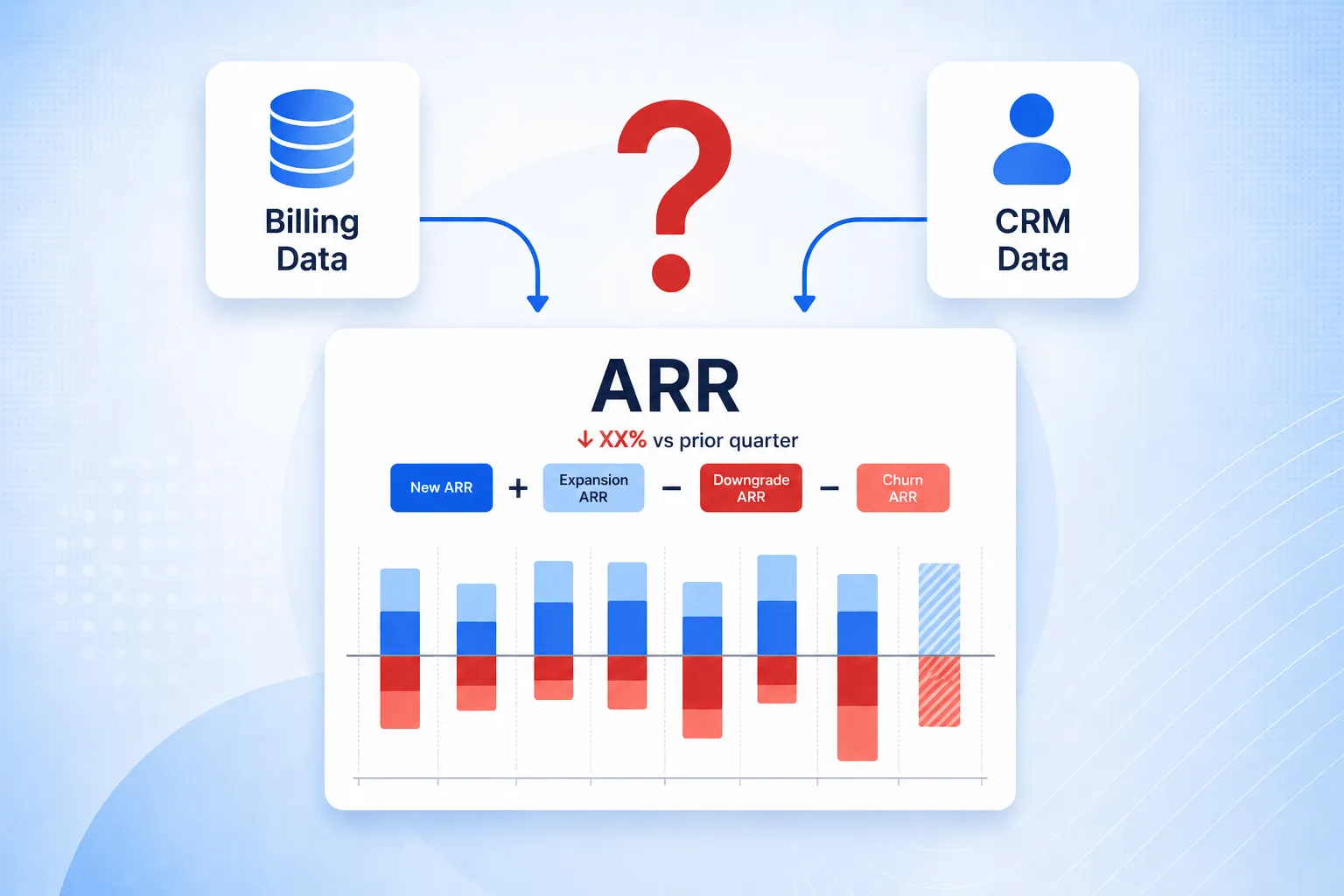
Account and customer hierarchies can change in one system but not another. A renewal is reflected in billing but not properly connected in the CRM. Contacts become stale. ARR or MRR logic differs between systems. An opportunity closes, but the corresponding invoice or subscription does not align.
Individually, these may look like data hygiene issues.
Together, they create a much larger business problem.
Poor data quality does not stay isolated inside a CRM or data warehouse.
Finance teams spend more time reconciling ARR, MRR, contracts, renewals, churn, and expansion. CRM inconsistencies can reach billing and create revenue leakage. Dashboards inherit conflicting definitions. Customer and revenue metrics become harder to reconcile for board and investor reporting.
AI agents inherit the same problems.
If an agent is working from missing definitions, broken customer relationships, or conflicting metrics, connecting it to more systems does not necessarily create a better answer. It can simply give the agent more inconsistent information to reason from.
AI does not just need access to data. It needs data with reliable business context.
Traditional data quality efforts often focus on the record itself:
Is a required field missing? Is this account duplicated? Is the contact outdated? Is the domain valid?
Those checks matter, but they do not always explain why the problem exists.
A discrepancy between CRM and billing systems, for example, may be caused by inconsistent data entry. But it could also come from an integration failure, a timing or sync delay, a mapping conflict, unclear ownership, or a missing business process.
Correcting the record addresses the immediate issue.
Understanding the root cause helps prevent it from happening again.
This is why data quality needs to go beyond periodic cleanup. Companies need a way to identify discrepancies, trace where they came from, remediate them appropriately, and keep systems aligned over time.
A best-in-class data quality project combines automated scanning, Data Quality Agents, domain expertise, and human review to create a repeatable approach to data quality.
The process starts by connecting source systems and defining which identifiers represent the same record and which fields need to agree.
Consistent, automated comparisons are then run across systems to surface discrepancies, trace lineage, and classify root causes.
These issues can include:
Once an issue is identified, remediation depends on the risk and business context.
Low-risk fixes can be automated. Sensitive exceptions can be routed to the appropriate owner for review and approval. Approved changes can then be written back to source systems with an audit trail.
Discern operationalizes this approach through direct system connections, automated Data Quality Agents, expert review, governed write-backs, and ongoing monitoring. Rather than treating data quality as a periodic cleanup exercise, the goal is to establish a repeatable operating process that keeps systems aligned as the business changes.
Not every discrepancy should be resolved automatically.
Customer hierarchies, contract amendments, renewal structures, billing exceptions, and company-specific business rules often require context that cannot be determined from a single record.
Discern combines Data Quality Agents with expert review so straightforward fixes can be automated while more sensitive exceptions remain controlled.
This system-plus-human approach is designed to provide the scale of automation without removing judgment where business context matters.
Reliable AI requires more than clean individual records. It needs to understand how those records relate to the business.
Discern’s Customer Cube creates a customer-level view across revenue, ARR, retention, usage, support, payments, margin, growth, and other business data.
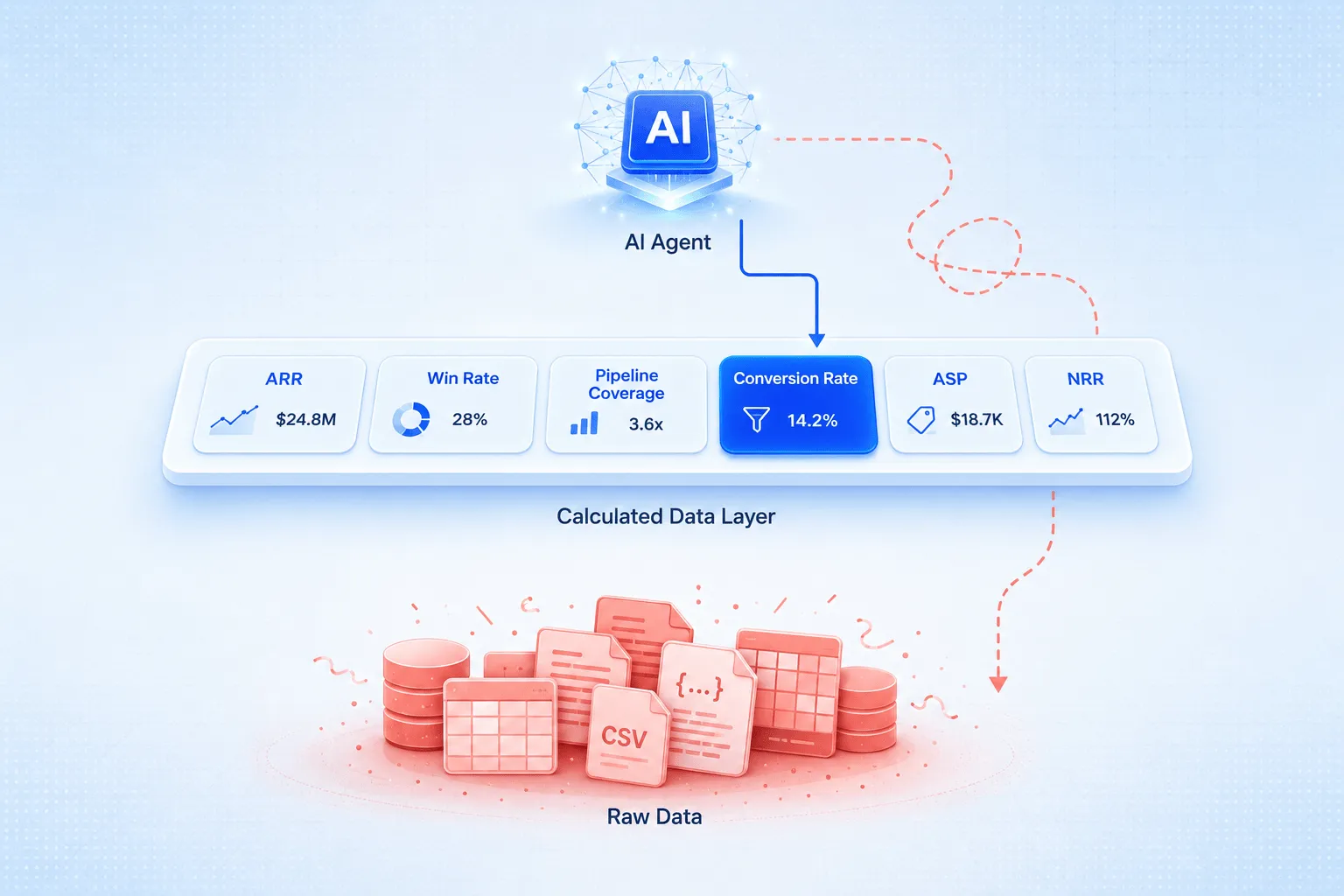
Instead of asking an AI agent to reconstruct a customer from fragmented source systems, the Customer Cube provides trusted definitions, relationships, and business metrics that can be used as context.
Raw data gives AI information. Governed data gives AI business context.
That foundation also supports the teams already relying on the same information.
For Finance, it means more defensible customer and revenue metrics that reconcile cleanly to GAAP or recognized revenue.
For Revenue Operations, it means a cleaner customer master, aligned subscriptions and renewals, and more complete CRM workflows.
For Data and IT, it means defined matching logic, visible lineage, controlled write-backs, and fewer manual spreadsheet comparisons.
As companies build more AI agents and automate more analytical and operational workflows, the quality of the underlying business data becomes increasingly important.
The question is not simply whether an organization has enough data.
It is whether that data is clean, consistently defined, connected, and governed well enough to support the decisions being made from it.
That requires more than a one-time cleanup.
It requires a repeatable process for establishing a baseline, finding root causes, remediating issues, and keeping systems aligned.
AI, reporting, and operational decisions are only as reliable as the business data behind them.
When CRM, billing, ERP, product, warehouse, and other systems disagree, the goal should not be to simply choose one version of the truth. The goal is to understand why the systems disagree, reconcile those differences, and establish a governed foundation that can be maintained over time.
Discern’s Data Quality Service brings together automated scanning, Data Quality Agents, domain expertise, human-in-the-loop governance, and ongoing monitoring to help companies create that foundation.
Establish the baseline. Find the root causes. Keep the systems aligned.
That is how fragmented business data becomes Investor-Grade Truth™ for reporting, operations, and AI.
A data quality project identifies and resolves inaccurate, incomplete, duplicated, stale, or inconsistent data across business systems. Best-in-class data quality projects go beyond cleaning individual records to identify root causes, reconcile systems, establish governance, and prevent the same issues from recurring.
AI depends on reliable data, definitions, and business relationships to produce trustworthy outputs. When data is fragmented or inconsistent across CRM, billing, ERP, and other systems, AI inherits those inconsistencies. Clean, governed data gives AI the business context it needs to produce more reliable answers.
Common issues include missing or inconsistent fields, duplicate records, broken customer hierarchies, disconnected opportunities, stale customer data, missing invoices, ARR or MRR logic conflicts, and inconsistent product, contract, subscription, or renewal mapping.
The process starts by defining how records, fields, and business logic should align across systems. Automated comparisons can then surface discrepancies, trace lineage, and identify root causes. Issues can be remediated through automated or human-reviewed changes, followed by ongoing monitoring to keep systems aligned.
Some data quality issues can be automatically identified and remediated, particularly low-risk fixes. More complex issues involving customer hierarchies, contracts, billing exceptions, or company-specific business rules may require human review and approval.
Human-in-the-loop data quality combines automation with expert review. Data Quality Agents can surface issues and automate appropriate fixes, while sensitive exceptions are routed to people who can apply the business context and judgment needed before changes are approved.
Discern’s Data Quality Service combines automated scanning, Data Quality Agents, domain expertise, human-in-the-loop governance, and ongoing monitoring to identify, investigate, and remediate data quality issues. Approved changes can be written back to source systems, helping companies establish and maintain Investor-Grade Truth™ for reporting, operations, and AI.
Join 30+ B2B software companies and PE firms that trust Discern for automated, board-ready analytics.
Book a Demo


4.8/5 100+ Reviews
Trusted by the world leaders